

﷽
The crescent moon is visible today (18 Feb 2026) in many parts of the world and photographs have been widely shared online.
The real question is this: if the moon was genuinely sighted yesterday (17 February 2026) in Saudi Arabia and other Gulf countries—despite visibility being implausible based on established standards—why were no photographs shared? If something considered impossible had truly been achieved, images would have been circulated to silence critics and detractors. Just one real image from a telescope could have been shared.
Why are all the available photos of the crescent from today (18 February) rather than yesterday?
Furthermore, the size of the crescent on any given day is irrelevant from an Islamic perspective. The Sharīʿah bases the ruling on the sighting and visibility of the crescent, not on its size.
Yesterday, the crescent would have been extremely thin, setting within minutes of sunset, with minimal elongation. Today, we already know that more than 24 hours have passed since conjunction and that the elongation exceeds 8°, making visibility easy in many regions without optical aid. Yesterday, however, the interval between conjunction (new moon) and sunset was only a few hours, and the moon set almost immediately after sunset.
No one denies that the crescent would appear larger today. This is simple astronomy, as more time has passed since conjunction. But being larger does not mean it is “the crescent of the next day.” That claim reflects a misunderstanding of the issue.
The Islamic criterion rests on actual sighting and visibility, not retroactive reasoning based on the crescent’s size. It was simply not visible yesterday by all established standards.
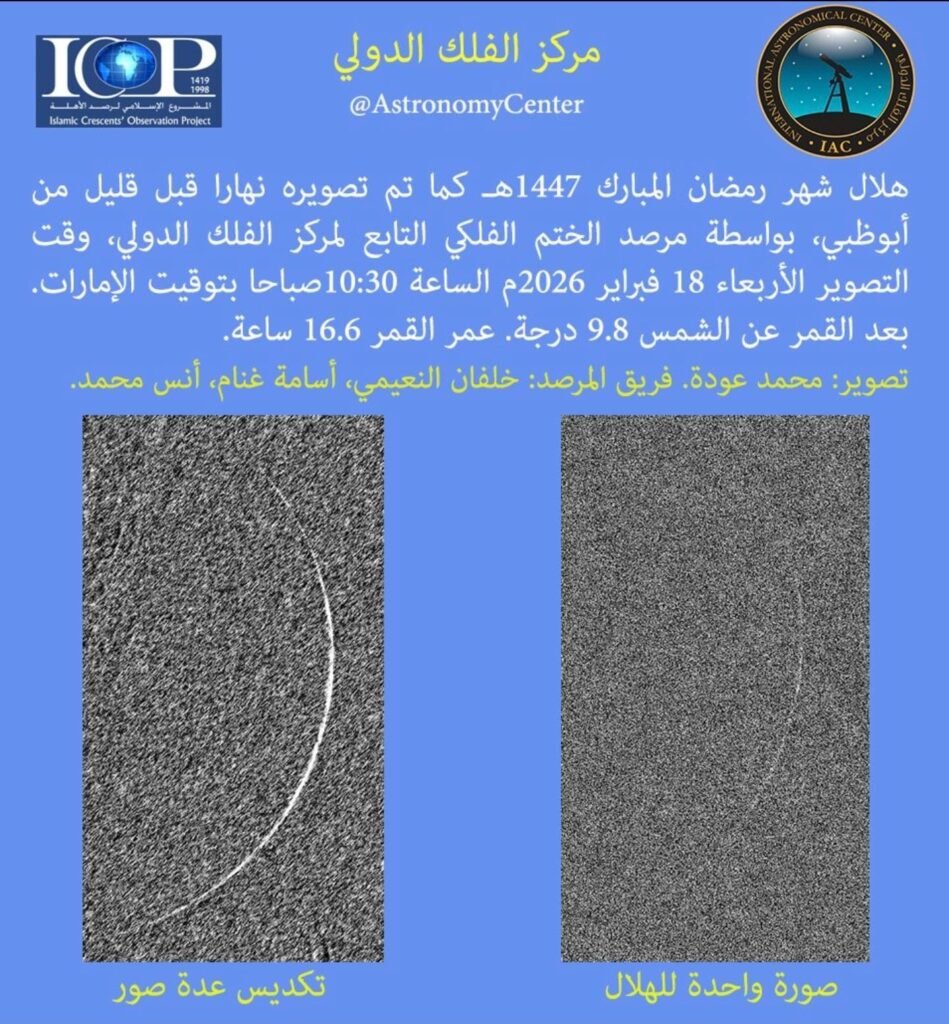
The above image shows an extremely thin crescent on 18 February at 10:30am UAE time. The elongation is 9.8°, and the moon’s age is 16.6 hours. If this is how thin the crescent appears after 16 hours (captured using a high-tech telescope) do you really think it would have been visible merely 3 hours after conjunction the previous day?
Seeing the moon within 3 hours of conjunction is considered impossible by all established astronomical standards. At that stage, the moon would still lie within the sun’s glare region, where the brightness of the sky near the sun overwhelms it completely. There is simply insufficient angular separation between the sun and the moon for the crescent to become visible.
At such an early age, the crescent’s illumination is extremely low, while the background twilight brightness remains far too high. The contrast ratio makes visibility unattainable. Historically, there has never been a reliably documented positive sighting within 3 hours of conjunction, not even with advanced telescopic equipment.
The Islamic standard is based on actual sighting of the crescent.

Muhammad Kalim Misbahi